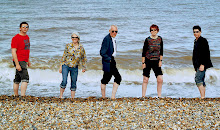
Joel Stickley makes me weep with laughter. Frex:
When writing radio drama, use dialogue to set the scene
Present your research in the form of dialogue
Always use a thesaurus
Joel is one of the poetry boyband Aisle 16.
15 November 2009

10 November 2009
Writer's Choice
My Writer's Choice is on normblog! Don't go there* expecting something highbrow or poetic. Although I wrestled with the idea of doing justice to various books that might make me look intelligent and cultured, I settled for what first came to mind: some of the first books I remember.

*Edit: I should add that of course you will frequently find things highbrow and poetic elsewhere in Norm's Writer's Choice series, and indeed on his blog in general.

*Edit: I should add that of course you will frequently find things highbrow and poetic elsewhere in Norm's Writer's Choice series, and indeed on his blog in general.
05 November 2009
The Workforce from Praga
Oh good, I thought, when this came up on Google alerts, a review at last. But "workforce"? Were they going to be accusing me of lucubrations?
So I wandered over and found myself in an alternative universe. As Gary Larson says of another malfunction entirely, the results are disquieting but inexplicably hilarious:
I love the way there is a different translation of "Men" each time, not all of them politically correct. I shall never again see the words "Albert Hall" without thinking of a humble corridor, and the neglected vaudeville entertainer, Albert Hallway. And when the going gets tough, I might well consider getting out mazed with Rebel Alien.
As for jamesmarshallko, the name behind this odd tribute, he seems to be a bot who has crawled over Peony Moon, extracted my poem and run it twice through a translation tool. In case there's any malware floating around, I'm not linking. It is hosted by livejournal, a place I normally associate with keen-eyed ficcers. I didn't click on any of the links over there, which probably take you to Canadian pharmacies or worse. I'm keeping this poem, though.
So I wandered over and found myself in an alternative universe. As Gary Larson says of another malfunction entirely, the results are disquieting but inexplicably hilarious:
Anne writes:I love "geezerhood"! I'm having that. I don't care really, so long as they've spelt my name correctly. And below that, they've printed the poem. They shouldn't really do that without permission, should they? I can tell it's my poem from the shape of it. But hang on, this isn't right. Not right at all:
"Besides as on recent 50p coins, Britannia employed to look on the old British pennies. The influence of society 's, and the province 's, demands on single individuality is something that holds upseted me for many geezerhood."
[That link above is a pukka link handcoded by me to take you directly to Salt.]
Britannia
Anne Berkeley
Careful not to bemire her delicacy Ferragamos,
the grand locomotes discreetly through the herbaceous borderline,
a bundle of cuttings in her bag:
a cardinal, the Queen 's gynecologist, a twelve QCs.
She holds come for the music, course,
but the ambience 's lovely, such elegant lampshades.
There is e'er some Authorities in the garden
where the sheep are maintained in their rightful spot
safely cropping beyond the haha.
There are twenty-two transactions before pall upwards.
The wind is cold, there Holds a whine of rainfall
but the outing must locomote along and be such merriment:
an unfastened window functions coloratura with rap de pate de foie gras.
Everyone holds a carpeting for their genus, and she reminds us
again of her dark at the Albert Hallway,
the swallowing blueness of a million delphiniums.
We can nighly believe in her cloak-pin and shield.
It Holds not what it was, she states: the coarse new edifice,
annually the way to the lily pond more overgrown -
a dialolog of green blackberries and birtwistle.
Hemlines are uprise; already comptrollers rinse au fait the lawn.
Even today, out mazed with Rebel Alien,
I hear her jubilant arpeggios over the waves,
the Broadwood 's V policing round the fiddles.
Britannica ' is printed in The Manpower from Praga
( Salt Publication, 2009 ).
Read more about Anne and The Hands from Praga
I love the way there is a different translation of "Men" each time, not all of them politically correct. I shall never again see the words "Albert Hall" without thinking of a humble corridor, and the neglected vaudeville entertainer, Albert Hallway. And when the going gets tough, I might well consider getting out mazed with Rebel Alien.
As for jamesmarshallko, the name behind this odd tribute, he seems to be a bot who has crawled over Peony Moon, extracted my poem and run it twice through a translation tool. In case there's any malware floating around, I'm not linking. It is hosted by livejournal, a place I normally associate with keen-eyed ficcers. I didn't click on any of the links over there, which probably take you to Canadian pharmacies or worse. I'm keeping this poem, though.
25 October 2009
if it doesn't come bursting out of youI was at a reading tonight where a friend read this poem, one of his favourites. The audience cheered. Part of me cheers too, finding congruence with Keats writing to his publisher: if Poetry comes not as naturally as the leaves to a tree it had better not come at all. I certainly feel like cheering when I get to this bit:
in spite of everything,
don't do it.
unless it comes unasked out of your
heart and your mind and your mouth
and your gut,
don't do it.
if you have to sit for hours
staring at your computer screen
or hunched over your
typewriter
searching for words,
don't do it.
Charles Bukowski - so you want to be a writer?
don't be dull and boring andBut he is wrong. Seductive, but wrong. The poem ends like this:
pretentious, don't be consumed with self-
love.
the libraries of the world have
yawned themselves to
sleep
over your kind.
and if you have been chosen,A dictum that would have condemned Elizabeth Bishop, who spent years looking for the right word, to silence. And think of Plath, whom Hughes described working with a thesaurus on her lap.
it will do it by
itself and it will keep on doing it
until you die or it dies in you.
there is no other way.
and there never was.
The thing that most riles me - for a moment - is the prescriptivism. One of the chosen defines who else is chosen. It would be tempting to discuss the soteriology underlying that word "chosen" if one could have more confidence that the word itself had been chosen rather than simply occurred as, say, leaves to a tree.
Romantics. Men channelling the collective unconscious. Duende. Let them talk for themselves. But they are not simply talking about themselves, they are also talking about the way they would like to write. Or at least, the way they'd like to be seen to write. The skill is in making it look natural. Poetry favours the prepared mind. Those poems that come quickly and seem to need little revision - don't they arouse suspicion? It shouldn't be that easy. That way lets in cliché, lazy thinking, push-button emotions, rhymes that are there for no other reason than the sound.
Keats was one of my first loves. Bukowski bores me. I'm irritated at the dismissal of work. Keats took dictation from his prepared mind. Bukowski, not so much. Bishop took the protestant work ethic to an extreme. Hey, even the sainted Don Paterson claims to write dozens of drafts. There's room for everyone.
Poetry can come from the head, the heart, the toil or the soil - what matters is where it lodges. It doesn't matter how long it took to fashion the arrow, if it finds its mark.
09 October 2009
Andrew Philip

Congratulations to Andrew Philip for making the Aldeburgh shortlist against stiff competition from 92 other first collections.
I highly recommend The Ambulance Box. The Squared interview with Andy is here.
The final winner will be announced at Aldeburgh Poetry Festival on 7 November.

01 October 2009
See How I Land
"Come, talk, laugh and break isolation"- Vahni Capildeo ("Filda's Workshop")
This book collects new writing arising from the Oxford Poets & Refugees project - an initiative of the Oxford Brookes Poetry Centre and the Oxford-based charity Asylum Welcome.
In See How I Land the intersection of arts and human rights is vividly demonstrated… It asks us to think again about what it is that we, as humans, value, what it is that we share, and what it is that we desire to protect and to celebrate: freedom, safety, family, and love.– Shami Chakrabarti
Asylum seekers and poets are both searching. Refugees are trying to find a haven for themselves and their families, writers a home for stories, dreams and ideas… When Oxford Brookes brings these two worlds together they give us ‘outsiders’ a place where all our words, and all our lives, are valued.– Benjamin Zephaniah
I'll be writing about it soon.
Misunderstood
I don't often do quizzes, but this one appealed.
Your recommended philosophy-guru is EPICURUS.
Key fact: Epicurus, founder of Epicureanism, is probably the most misunderstood philosopher of antiquity.
Must have: A delight in the countryside and gardens.
Key promise: Peace and tranquillity.
Key peril: Boredom.
Most likely to say: "The true hedonist can find as much pleasure in a glass of chilled water as in a feast for a king."
Least likely to say: "He who tires of the city, tires of life."
Via.
Ars longa, vita brevis
Petition for Roman Polanski
We have learned the astonishing news of Roman Polanski’s arrest by the Swiss police on September 26th, upon arrival in Zurich (Switzerland) while on his way to a film festival where he was due to receive an award for his career in filmmaking. He's a great film maker.
His arrest follows an American arrest warrant dating from 1978an awfully long time ago. Don't you think we can just let bygones be bygones?
against the filmmaker, in a case of morals.We don't judge other people by standards of bourgeois morality.
Filmmakers in France, in Europe, in the United States and around the world are dismayed by this decision. It seems inadmissible to them that an international cultural event, paying homage to one of the greatest contemporary filmmakers, is used by the police to apprehend him.He's a great film maker. We all think so. You can't go around arresting great guys like that. Film festivals are sacrosanct. This is tantamount to arresting a priest in church.
By their extraterritorial nature, film festivals the world over have always permitted works to be shown and for filmmakers to present them freely and safely, even when certain States opposed this.We claim diplomatic immunity for our event. Otherwise, what next? They will be arresting people for showing films that someone doesn't like. This is like McCarthysism.
The arrest of Roman Polanski in a neutral country,Switzerland was neutral in WWII, and is not a member of NATO or the EU and it's um we think it's probably therefore neutral in the enforcement of cases of morals
where he assumed he could travel without hindrance,He's been able to get away with it for so long he thought he could get away with it this time.
undermines this tradition: it opens the way for actions of which no one can know the effects.What next? They will be arresting people for showing films that someone doesn't like. This is like McCarthysism.
Roman Polanski is a French citizen, a renowned and international artist now facing extradition.He should be immune from your bourgeois American moral judgements.
This extradition, if it takes place, will be heavy in consequences and will take away his freedom.And he should be free, because he's a great film maker.
Filmmakers, actors, producers and technicians—everyone involved in international filmmaking — want him to know that he has their support and friendship.He is one of us. He is our friend.
On September 16th, 2009, Mr. Charles Rivkin, the US Ambassador to France, received French artists and intellectuals at the embassy. He presented to them the new Minister Counselor for Public Affairs at the embassy, Ms Judith Baroody. In perfect French she lauded the Franco-American friendship and recommended the development of cultural relations between our two countries.We appeal to all enlightened French-speaking people
If only in the name of this friendship between our two countries, we demand the immediate release of Roman Polanski.
* * *
If a friend of mine were threatened with jail I'd go to some lengths to help keep them out, and if they went to jail I'd go and visit. (Assuming they hadn't done something so gross I didn't want to stay friends.) I'm not going to boycott anyone for signing this petition. There are many people I like and admire who support it. I just think their arguments are woolly.
It's a long time ago.
OK, so you want a statute of limitations for rape. Some jurisdictions have that. No doubt some elderly clergymen wish they had the benefit of a statute of limitations. But you will have to make a better argument than this. He's hardly Jean Valjean is he.
Hollywood, rock stars, the golden days - everyone was messing around with kids back then.
There have been powerful people indulging their urges since time immoral, and society sometimes lets them get away with it. Then people start thinking you can get away with it if you're rich and influential enough. There is never a shortage of victims. There should have been a lot more prosecutions. Why should an auteur be treated differently from a priest, or someone who lives in a trailer?
Her mother knew all about it.
The victim was thirteen. I don't know what her mother has to do with it. (It's a pity she didn't stay around during the shoot.) The sexuality of children isn't - in western society at least - the property of their parents. How many times did that kid say No? I've lost count, but it was a lot.
The victim wants it dropped.
And some offences are so difficult or humiliating that the victim may not want to talk about them. But unless the offence is really trivial, the victim shouldn't have a say in the matter. Otherwise the perp would be able to intimidate the victim into dropping charges, or if they were rich enough, buy the victim off.
But he's Roman Polanski! He makes great films! What about Chaucer, Villon, Marlowe, Byron, Wilde, Eric Gill &c, &c?
Let's separate the man from his work.
And why focus on him when there are all these other guys running around evading prosection?
Because of the petition. People like me are sounding off because we don't think the petition should be unchallenged. We may speculate on why it's taken the US so long to catch him, and why now. They need to catch the other guys as well.
Feelings are running high. There's wild talk of witch hunts, of pitchforks and torches, of lynch mobs. This isn't Salem, it isn't McCarthyism, and it trivialises what the Ku Klux Klan did. It's not even as if Polanski can be claimed an innocent man. It's not totally unreasonable, is it, to call these celebs out on their assumption of entitlement to immunity?
[Edited to remove link to victim's testimony.]
29 September 2009
Weblog
As any fule no, a blog is a weblog, and it started out by being a list of sites visited. As an antidote to Blytonia, here are some of the more interesting items I've come across in the past few days.
Jim Murdoch ponders the dearth of modern nursery rhymes.
Lorna Watts is refused the loan of scissors by a north London librarian: They are sharp, you might stab me.
Anton Vowl suggests what Gordon Brown should have answered to that question from Andrew Marr.
Belle Waring has an impassioned post on Crooked Timber about sexual harassment in the academy, with a sideswipe at "look but don't touch" Kealey from Buckingham. Mary Beard isn't so bothered. Is Terence Kealey as misunderstood as Juvenal? (Or as contemporary? I'm inclined to add.) Yes, it may have been satire, but it's pretty lame satire.
In a post entitled Because Men are Stupid and Shallow, That's Why, Jeff Fecke demonstrates that some men are capable of seeing the person beyond the breasts. He challenges the Canadian Rethink Breast Cancer campaign (aimed at raising men's awareness by concentrating on breasts):
Jack of Kent argues why English libel law is a danger and makes a proposal for reform.
Shuggy has a go at performative theists aiming for the class prize.
Right, I'm off to Oxford now for the launch of See How I Land.
Jim Murdoch ponders the dearth of modern nursery rhymes.
Lorna Watts is refused the loan of scissors by a north London librarian: They are sharp, you might stab me.
Anton Vowl suggests what Gordon Brown should have answered to that question from Andrew Marr.
Belle Waring has an impassioned post on Crooked Timber about sexual harassment in the academy, with a sideswipe at "look but don't touch" Kealey from Buckingham. Mary Beard isn't so bothered. Is Terence Kealey as misunderstood as Juvenal? (Or as contemporary? I'm inclined to add.) Yes, it may have been satire, but it's pretty lame satire.
In a post entitled Because Men are Stupid and Shallow, That's Why, Jeff Fecke demonstrates that some men are capable of seeing the person beyond the breasts. He challenges the Canadian Rethink Breast Cancer campaign (aimed at raising men's awareness by concentrating on breasts):
the thing about breasts that I generally like the most is that they’re usually attached to living, breathing women, and I like women, because, you know, they’re people. Many of them are people I like, and consider friends. All of them are worth far more than the breasts attached to them; that should go without saying.Ben Goldacre considers the AIDS-denialist film House of Numbers, which was shown at Cambridge Film Festival and (temporarily) hoodwinked rationalist sceptic Caspar Melville. Goldacre starts a lively discussion about how to deal with moonbats - exposure, ridicule, debate? Or by ignoring them? (There's no widely accepted noun for that, but ignoral might suit.) This comment in particular struck me:
The best advice my late Dad ever gave me was; “Never argue with an idiot, because people watching lose track of which is which”. The older I get, the more I appreciate his words. Several times a week, I’m given cause to think of them.Teach the debate is what creationists say.
Jack of Kent argues why English libel law is a danger and makes a proposal for reform.
Shuggy has a go at performative theists aiming for the class prize.
no man ever forsook his father, mother, brother, sister, son or daughter and took up his cross in order to support the nuclear family, preserve the work ethic, reduce crime in the neighbourhood or foster charitable giving as an important ingredient in civil society.Terry Glavin doesn't know how to handle the human tide, except that the handling should be humane. Who could disagree?
Right, I'm off to Oxford now for the launch of See How I Land.
27 September 2009
Antidote
[Emily asks: Did you enjoy the Blytons? Yes, like a drug. When I wasn’t reading them I’d be trying to work out how I could get away in secret for my next fix. It was the summer holiday, and my mother thought I should be out of doors. Normally I needed no encouragement, so she must have worked out that something was amiss. Inevitably, she discovered me in the act.]

- Said, said, said, said, said! My mother jabs her finger down the page. It’s so boring! She looks exasperated.
- But it’s not boring! It’s very exciting! I want to know what happens next.
- Said Julian, said Dick, said George. Didn't you notice? Proper reading is when you read the words.
She’s right. Why hadn’t I noticed?
- Look at this. She produces another red-covered book, the same size as Five Go to Smuggler's Top. My spirits lift for a moment, then I see the title: Just William. Richmal? Why do these writers all have funny names? The pictures aren’t as good as Eileen Soper’s. The boy doesn't look much older than me. He’s very scruffy. There isn’t anyone who looks as sensible as Julian. At least there’s a dog, but he’s not powerful like Timmy. I don’t think these children will be able to deal with grownup situations like smugglers and spies. But the print is small, which suggests it's for older children. It is confusing. I look again at the boy with his cap askew and his socks around his ankles. His face is grinning and dirty.
- That boy doesn’t look very reliable.
- He's got more life in his little finger than all this lot together.
I stare at his little finger, which is just a blur.
- I think you'll enjoy his company. But you can’t have it yet. Finish that Famous Five and come and tell me all about it. Then we’ll see.
* * *
My mother is right of course. She is always right. There is an art to writing that doesn’t draw attention to itself. But now she’s pointed it out, I can’t help noticing the saids, and that’s done for it.
William hardly ever just “says” anything. He’s forever exclaiming, proclaiming, conjecturing, expostulating, reasoning, arguing, protesting and even ejaculating. (Ah that will get me some Google traffic. But those were the days when social intercourse was polite.) I get the impression of a boy with a very mobile face.
Sometimes I need to ask the meaning of a word, and the tubby, child-sized COD has become a dear friend. But that's another story.

- Said, said, said, said, said! My mother jabs her finger down the page. It’s so boring! She looks exasperated.
- But it’s not boring! It’s very exciting! I want to know what happens next.
- Said Julian, said Dick, said George. Didn't you notice? Proper reading is when you read the words.
She’s right. Why hadn’t I noticed?
- Look at this. She produces another red-covered book, the same size as Five Go to Smuggler's Top. My spirits lift for a moment, then I see the title: Just William. Richmal? Why do these writers all have funny names? The pictures aren’t as good as Eileen Soper’s. The boy doesn't look much older than me. He’s very scruffy. There isn’t anyone who looks as sensible as Julian. At least there’s a dog, but he’s not powerful like Timmy. I don’t think these children will be able to deal with grownup situations like smugglers and spies. But the print is small, which suggests it's for older children. It is confusing. I look again at the boy with his cap askew and his socks around his ankles. His face is grinning and dirty.
- That boy doesn’t look very reliable.
- He's got more life in his little finger than all this lot together.
I stare at his little finger, which is just a blur.
- I think you'll enjoy his company. But you can’t have it yet. Finish that Famous Five and come and tell me all about it. Then we’ll see.
* * *
My mother is right of course. She is always right. There is an art to writing that doesn’t draw attention to itself. But now she’s pointed it out, I can’t help noticing the saids, and that’s done for it.
William hardly ever just “says” anything. He’s forever exclaiming, proclaiming, conjecturing, expostulating, reasoning, arguing, protesting and even ejaculating. (Ah that will get me some Google traffic. But those were the days when social intercourse was polite.) I get the impression of a boy with a very mobile face.
Sometimes I need to ask the meaning of a word, and the tubby, child-sized COD has become a dear friend. But that's another story.
24 September 2009
Issues
Gmail is temporarily unable to access your Contacts. You may experience issues while this persists.
Issues? The mind boggles.
Of course I know what they mean, but it's the first time I've seen this used formally and it piqued my interest.
Here's dictionary.com:
Then some similar definitions from another source including additionally:
Further down the page:
What's the problem with problem? Anway, why didn't Gmail just stop after the first sentence? I get the impression that "problem" isn't a sufficiently empathetic word for their purposes as they want to convey the nuance that We know that when things go wrong people get upset. I hope I'm wrong. It's infantilising. Not everyone gets upset, and it's something we all try to grow out of. If they wanted to convey a warm fuzzy Googly feeling, an apology might have done the trick.
Issues? The mind boggles.
Of course I know what they mean, but it's the first time I've seen this used formally and it piqued my interest.
Here's dictionary.com:
1. the act of sending out or putting forth; promulgation; distribution: the issue of food and blankets to flood victims.Nope, None of those. On the contrary.
2. something that is printed or published and distributed, esp. a given number of a periodical: Have you seen the latest issue of the magazine?
3. something that is sent out or put forth in any form.
4. a quantity of something that is officially offered for sale or put into circulation at one time: a new issue of commemorative stamps; a new bond issue.
5. a point in question or a matter that is in dispute, as between contending parties in an action at law.
6. a point, matter, or dispute, the decision of which is of special or public importance: the political issues.
7. a point the decision of which determines a matter: The real issue in the strike was the right to bargain collectively.
8. a point at which a matter is ready for decision: to bring a case to an issue.
9. something proceeding from any source, as a product, effect, result, or consequence: His words were the issue of an intelligent man.
10. the ultimate result, event, or outcome of a proceeding, affair, etc.: the issue of a contest.
11. a distribution of food rations, clothing, equipment, or ammunition to a number of officers or enlisted soldiers, or to a military unit.
12. offspring; progeny: to die without issue.
13. a going, coming, passing, or flowing out: free issue and entry.
14. a place or means of egress; outlet or exit.
15. something that comes out, as an outflowing stream.
16. Pathology. a. a discharge of blood, pus, or the like.
b. an incision, ulcer, or the like, emitting such a discharge.
17. issues, English Law. the profits from land or other property.
18. the printing of copies of a work from the original setting of type with some slight changes: the third issue of the poem.
19. Obsolete. a proceeding or action.
Dictionary.com Unabridged
Based on the Random House Dictionary, © Random House, Inc. 2009.
Then some similar definitions from another source including additionally:
Informal A personal problem or emotional disorder: The teacher discussed the child's issues with his parents.Not that either. I try to keep sane when the computer plays up.
The American Heritage® Dictionary of the English Language, Fourth Edition
Copyright © 2009 by Houghton Mifflin Company.
Published by Houghton Mifflin Company. All rights reserved.
Further down the page:
Slang dictionaryThe car thing.
n.
problem. (In colloquial use, issue has virtually replaced the word problem. It is even heard in a few idioms such as Do you have an issue with that?) : I had an issue with my car this morning. It wouldn't start. , You are late again! Do you have an issue with our office hours?
Dictionary of American Slang and Colloquial Expressions by Richard A. Spears.Fourth Edition.
Copyright 2007. Published by McGraw Hill
What's the problem with problem? Anway, why didn't Gmail just stop after the first sentence? I get the impression that "problem" isn't a sufficiently empathetic word for their purposes as they want to convey the nuance that We know that when things go wrong people get upset. I hope I'm wrong. It's infantilising. Not everyone gets upset, and it's something we all try to grow out of. If they wanted to convey a warm fuzzy Googly feeling, an apology might have done the trick.
23 September 2009
Torch under bedclothes
By balancing the stool on the chair, I can just reach the top of the wardrobe. I know it’s silly and dangerous, but I’m sensible and a good climber. I’ll get into trouble if anyone catches me.
It’ll be worth it.
Up there under the ceiling is a cardboard box full of books the new vet carried into our kitchen when he arrived for supper yesterday, announcing: Anne would like these. Out of politeness he’s allowed to show what’s in there: a glimpse of maroon, occasionally light blue bare boards, dust jackets long gone: a dozen fat volumes – twenty perhaps. All the same size, the same but different. A collection! On the bottom right hand corner is impressed an almost illegible signature, which seems to say Cuid Blyton. Cuid is a funny name, I think, but the titles are irresistible: Five on a Treasure Island, Five Go to Smugglers’ Top. For me! All night, and all the next day, unread adventures torment me: Five Go to Mystery Moor, Five Go Off to Camp, Five Go to Billycock Hill.
My mother deems them “unsuitable”. You can read them when you’re old enough, she says.
It’s not fair. She knows I am a good reader. The headmaster calls us in for reading tests. He says, I don’t know why I bother with you and Christine Simpson, I only call you in to cheer myself up. He puts his arm round me in a fatherly way. I have a reading age of fourteen.
It is only years later that I realise my mother meant when you’re old enough to recognise them for the trash they are.
Meanwhile, here I am, tiptoe on the stool balanced on the chair, stretching for the forbidden books in the cardboard box just too high for me to reach. I try jumping. The stool rocks alarmingly. Only by tugging and tearing a corner of the cardboard can I get a hold on one. It’s alright, no one will look on top of the wardrobe until Christmas time, by when I’ll be old enough to say I was much younger when I committed the crime. They might even think the box was torn already. So I dip in and grab a book.
Five On a Treasure Island. The vet is a methodical man. It’s the first in the series.
It’ll be worth it.
Up there under the ceiling is a cardboard box full of books the new vet carried into our kitchen when he arrived for supper yesterday, announcing: Anne would like these. Out of politeness he’s allowed to show what’s in there: a glimpse of maroon, occasionally light blue bare boards, dust jackets long gone: a dozen fat volumes – twenty perhaps. All the same size, the same but different. A collection! On the bottom right hand corner is impressed an almost illegible signature, which seems to say Cuid Blyton. Cuid is a funny name, I think, but the titles are irresistible: Five on a Treasure Island, Five Go to Smugglers’ Top. For me! All night, and all the next day, unread adventures torment me: Five Go to Mystery Moor, Five Go Off to Camp, Five Go to Billycock Hill.
My mother deems them “unsuitable”. You can read them when you’re old enough, she says.
It’s not fair. She knows I am a good reader. The headmaster calls us in for reading tests. He says, I don’t know why I bother with you and Christine Simpson, I only call you in to cheer myself up. He puts his arm round me in a fatherly way. I have a reading age of fourteen.
It is only years later that I realise my mother meant when you’re old enough to recognise them for the trash they are.
Meanwhile, here I am, tiptoe on the stool balanced on the chair, stretching for the forbidden books in the cardboard box just too high for me to reach. I try jumping. The stool rocks alarmingly. Only by tugging and tearing a corner of the cardboard can I get a hold on one. It’s alright, no one will look on top of the wardrobe until Christmas time, by when I’ll be old enough to say I was much younger when I committed the crime. They might even think the box was torn already. So I dip in and grab a book.
Five On a Treasure Island. The vet is a methodical man. It’s the first in the series.
17 September 2009
How different from the home life of an ordinary person
For reasons we won't go into, this morning I found myself listening to William Shawcross being interviewed by Jenni Murray on Woman's Hour about his new biography of the late Queen Mother. What an extraordinary piece of radio. The Royal Family is an anachronism, useful as trade ambassadors and tourist attraction. And - in principle anyway - it is a good thing for the Prime Minister to have someone to defer to. (Imagine Blair as head of state. Or Cameron for that matter.) But, while Murray has no time for this gilded, profligate life and sense of entitlement, Shawcross adores his subject. I'm on Murray's side in this. Yet through Shawcross's passion one can also glimpse Murray from his point of view: shrewish, petty, practically philistine. But she keeps her cool.
After the abdication, the war, Diana, the alleged colostomy - the fun starts at around 11 minutes in:
JM: One of the other things she was criticised for was her profligate lifestyle, and she seems to have almost gaily announced that she might go bankrupt. Why did she live in such splendour?
WS: Because she enjoyed it. Because she grew up to that. She was one of the last of generations of people, of aristocrats, who weren't ashamed of their birth and the concept of noblesse oblige, she wasn't ashamed of giving employment to lots of people and having a jolly good life. And she enjoyed it, she could afford it, and she certainly lived better than you and I do. And why not?
JM: Could she afford it?
WS: She gave a huge amount of pleasure -
JM: She did have an overdraft
WS: Of course. Have you never had an overdraft?
JM: (Pause) I'm not the Queen Mum.
WS: I've had overdrafts. I couldn't live without an overdraft. (laughs) Always begging the bank manager not to come down too heavy on me
JM: But she had thirty three staff and she had -
WS: (interrupting) Why do you go on about this?
JM: - she had - Because it's fascinating -
WS: It's so silly, Jenni, this is an incredibly important woman, who epitomised this country through the whole of the second world war. She held the country together after the abdication, she created - she enabled her husband who was a hesitant, but adorable man, whom she was devoted to, she enabled him to take over the throne in very difficult circumstances, when a lot of people thought the monarchy was finished in 1936. She personified and symbolised this country. Churchill won the war for us but she and the King sustained the British people through six years of terror and horror, and that's what matters, and you go on about her staff. It's pathetic actually,
JM: - it -
WS: that doesn't really matter, I'm really surprised at you.
JM: - if she -
WS: You're one of the, you're the Queen Mother of Broadcasting and all you can think about is her staff and her illnesses. (fiercely) It's very very funny -
JM: I think people would be fascinated if they thought I had my menus hand-written in French every night, don't you?
WS: No - I well, they might well be fascinated if you do but why shouldn't she?
JM: You met her didn't you -
WS: Yes
JM: - on a couple of occasions and you clearly adored her.
WS: Yes I do adore her! And everyone adored her! Her staff stayed with her for thirty years. Nobody wanted to leave her. One of her pages who'd been with her for twenty five, twenty six years, um, on her hundredth birthday, he was very very ill, he stayed with her till her hundredth birthday so he could take her her morning coffee but went into hospital and died two days later. He kept himself going for her, just to be there for her hundredth birthday. And I hope this is what this book puts over, that she was a woman who was much loved, not just by the millions of people who didn't know her, but even more importantly by the people who worked for her, who knew her well, and I think that's - well, I mean - that's a celebration, something to be celebrated, and I was jolly lucky to be able to have this treasure trove of all her letters of a hundred years.
(Etc.)
...an incredibly important woman... What?
Do listen again before it disappears.
That story of the servant disturbs me. What was his name? Was his loyalty, sense of duty, misplaced? You'd think a sensitive employer would have had him off to the doctor sharpish, but people are not easily or kindly separated from their objects of veneration. He might have been cruelly disappointed if denied the opportunity to serve. Perhaps HMQM was working on that assumption.
By the way, Shawcross and Pan MacMillan are getting a lot of mileage on the BBC today. Nice publicity if you can get it.
William Shawcross is 63.
01 September 2009
Councillors pointing at things
 Cllr Neil Williams draws attention to a road defect
 Glum Councillors:
This blog will doggedly collate images of councillors looking glum whilst pointing at holes in the road, wearing hard hats or presenting oversized cheques. Lets celebrate the work of our local elected representatives! Tweet suggestions to @glumcouncillorsVia.
It's easy to mock. I blame the photographers. Or perhaps the editors. The posed photograph of someone looking glum while pointing at a pothole is a staple of local newspapers. Which come to think of it are under threat not just from the internet, but allegedly from what Roy Greenslade calls the "local Pravdas" produced by, erm, councils. The councils' glossy, clourful, fun-packed magazines are a fast breeding species, full of jolly news of filled potholes, pie-charts, bin collection dates, keep-fit classes and tips on healthy eating. Greenslade may have a point, though it reminds me uncomfortably of the point James Murdoch was making about the BBC. You know, where he was saying that free content on the BBC website was unfair competition for newspapers.
I admit it. It's partly my fault. I rarely buy a local paper.
I didn't go to the pub much either, and look what's happening to them.

[Crap Photo Editions: No Smoking]
30 August 2009
Abducted. Abused. Raped. Survived
The header is a quote from The Observer. It should make headlines when a girl minding her own business going to school is snatched away to spend her life with a stranger, and forced to bear him children. But it's not the story everyone's talking about, and it's more common than you might think.
Each year there may be as many as 4000 cases of forced marriage involving British residents.
At least there's a law against it here now, though some claim it doesn't go far enough.
The problem is far wider than forced marriage - as if that weren't bad enough - and it's global.
And a better than average CiF, from Victoria Brittain, here.
Amnesty International. Here's the link.
Each year there may be as many as 4000 cases of forced marriage involving British residents.
At least there's a law against it here now, though some claim it doesn't go far enough.
The problem is far wider than forced marriage - as if that weren't bad enough - and it's global.
Violence against women and girls is a human rights scandal; from the bedroom to the battlefield, from the schoolyard to the work place, women and girls are at risk from rape and other forms of sexual violence.
The response of governments to rape and other forms of sexual violence is still inadequate.
Amnesty International
And a better than average CiF, from Victoria Brittain, here.
Amnesty International. Here's the link.
22 August 2009
Look like if the words are bleeding

Photo and artwork: Theodore Diran Lyons III
A US college art teacher makes an art installation of his students' abandoned essays - which he marked but they never bothered to pick up - to illustrate his thesis that too many people are admitted to higher education without adequate literacy skills. For the purposes of the display he anonymises and red-pens the uncollected essays to highlight the errors.
Commenters are outraged that he has appropriated students' work, that he is not showing proper respect to his students, that he is not teaching writing in an effective way, that he is misdefining "mistakes" as illiteracy, and that in concentrating on the medium rather than the message he is focusing on an irrelevant skill. He engages his critics with surprising stamina.
The USA is not alone in having a problem with poor language skills. According to The National Literacy Trust, "one in six people in the UK struggle to read and write." Hmm. They don't give a source for that figure. "Dismal", says the chair of the Public Accounts Committee. Here in the UK Lyons would be similarly criticised for using students' work like this. But it doesn't make the problem go away.
Via.
05 August 2009
At home with the box

Hebridean Thumbnail 1
fo cheò
islands buried in the sky’s white sands
Andrew Philip
(fo cheò: 'mist-covered')
Today I'm delighted to welcome my first ever virtual guest, Andrew Philip. I bought his collection The Ambulance Box back in May when Salt launched their Just One Book Campaign. It's an impressive first collection, assured and purposeful. Nothing idles; the language sings, as alive as his curiosity about the world. His training as a linguist shines through in the precision of his words and his scrupulous awareness of the contingency of everything. This is a book full of questioning, with no easy answers. The salves in the Ambulance Box are astringent.
Note: Andrew Philip was born in Aberdeen in 1975 and grew up near Falkirk. He lived in Berlin for a short spell in the 1990s before studying linguistics at Edinburgh University. He has published two poetry pamphlets with HappenStance Press —Tonguefire (2005, sold out) and Andrew Philip: A Sampler (2008) — and was chosen as a Scottish Poetry Library “New Voice” in 2006.
The Ambulance Box is his first book of poems. It is dedicated to Aidan Michael Philip, the poet's son and first-born child, who died shortly after birth in 2005.
Andrew blogs at Tonguefire. You will find links there to many of his poems and essays, and a Scots glossary.
Since June, Andrew has been on a demanding virtual tour explaining himself to other bloggers. I add to their number with some nerdy questions of my own.

Welcome, Andy, and congratulations to you and Judith on the arrival of Cerys Ilona!
Q When I read the first poem in The Ambulance Box, I thought "here's a man who knows what he's doing!" and was immediately hooked. But as a writer myself, I know it probably took some courage to open with a one-liner. Is there a story behind that?
AP The first poem in a book is obviously an important one, and I spent ages agonising over which was the right piece to place first. I wasn’t happy that any of the poems of more normal length worked as openers and I wanted to thread the Hebridean Thumbnails — the one-line poems in the book — through the collection, using them to link what felt like different sections, so I bit the bullet and put one of them first. I was pleased with the way it worked so I’m delighted it hooked you. I suspect some people will love that approach and others not, but I think it invites readers into the more contemplative aspects of the book from the word go.
Q You have mentioned working with Rob Mackenzie to hone each other's collection before submission. You have quite different styles, and have each produced sharp and distinctive collections. Would your collection have been very different without these exchanges? How do you rate mentoring, workshops and colleagues in your development?
AP It wouldn’t have been so tight at the submission stage, that’s for sure. Rob’s comments were particularly useful in helping me to decide what poems to leave out. There were also a couple he gave me the confidence to include. For example, I felt that “Berlin/Berlin/Berlin” was a strong piece but was uncertain about how well it would come across to most readers. Slightly to my surprise and much to my delight, Rob rated it as one of the best, so I kept it in.
Creative friendships and relationships like that are surely important to all artists. I’m not a member of any formal, regular writing workshop or writer’s group, so such relationships are particularly important to me. I send poems for comment to people I trust and I’ve learnt a lot that way. In the end, you have to trust your own judgment, but a good critical reading by a fellow poet can help to identify strengths or problems you knew were there but couldn’t quite see. In fact, that person needn’t necessarily be a poet; my wife is generally my first reader and often makes astute comments even though she reads very little poetry. You need people around you who will tell you when they think you’re writing rubbish, even if you don’t always agree!
Although I’ve not been in any formal mentoring scheme for my writing, I’ve benefitted enormously from the advice and encouragement of the poet Michael Symmons Roberts. The fact that someone of his stature would take my work seriously was an enormous boost, especially in the early days of constant magazine rejections. But I might never have come across him had it not been for Roddy Lumsden, who encouraged me when I was a student. I happened to be at Edinburgh University at a good time: Matthew Hollis, Sinéad Wilson and Andrew Neilson were active in student poetry at that point, and Roddy took an active interest in our work.
Q You use a lot of formal devices in your work. Is constraint an ignition, or is it a brake?
AP A good constraint is probably both. Even if it isn’t part of the initial impetus for a poem, it can ignite further lines and images at the same time as helping to shape the material. After all, constraint is an integral part of all art, no matter how free. Even aleatoric art involves constraints of some kind.
Q So how does a poem start?
AP Generally with a word, a phrase or an image. Sometimes a formal device suggests itself and then sparks the words and images, but I can’t get down to work without a linguistic hook of some kind.
Q And how do you finish? How do you know when you've finished?
AP That is a trickier question altogether! There’s no easy answer. It’s intuition as much as anything, and one you have to develop. I suppose that, at some point, the impetus leaves the poem and you have to give it up. I sometimes change my mind about whether certain poems are finished, but I’m unlikely to do an Auden and make significant revisions to poems that have already been collected.
Q Some of your poems are in Scots and some in English. Are you a different person in each case, and are you addressing a different audience?
AP It may be that slightly different aspects of me come out in Scots and in English, as is the case in speaking any two languages, but I think I’m largely the same person. I don’t think of myself as addressing a different audience so much as addressing parts of my audience differently. For instance, what really determines how much readers enjoy “The Meisure o a Nation” is how much they get the references that make up the poem’s equations, not the density of the Scots.
Q As a non-Scot, I don't feel shut out from these, though I do feel a guest in foreign territory, without recourse to my usual conventions. So they are disarming in a way that an English poem wouldn't be. Is that a conscious strategy?
AP That’s interesting. I wouldn’t say it was a conscious strategy, but it’s a useful effect. It’s more that I’m inviting non-Scots readers into the language and all my reasons for using it, which I’ve discussed to some extent in previous stops on this tour. In using Scots, English and Gaelic, I aim to be linguistically inclusive and I hope that the reader feels that spirit of inclusion.
Q Salt produce beautiful books. (I would say that wouldn't I, but even on an objective test they are outstanding.) How do you see poetry publishing developing, and are new media a threat, or a promise of a much wider audience?
AP The ease with which writers can now make their work available globally, including through video and audio, is surely a great boost to their efforts to build an audience. Blogging has certainly helped me to widen my audience geographically, but I’m not sure whether it’s had an effect demographically.
If there’s a threat from the new media, it’s the expectation of free content that is associated with their use. How writers manage that without it destroying the meagre income from their work, I’m not sure.
I’m not convinced that e-books will ever replace the hard copy entirely, but they could open up interesting new avenues for enriching the audience’s experience of the poetry. If poetry e-books with embedded or linked audio and/or video became commonplace, that might be very healthy for the art. Perhaps Bloodaxe are already on the way there by bundling DVDs in with their In Person anthology and the new edition of Bunting’s Briggflatts.
Q Well, the free content on the Salt site certainly persuaded me to get this book! So what are you working on right now?
AP I’m always reticent about talking too much about unfinished work in case it robs me of the drive to carry out the ideas. However, I feel like I’ve begun to hit my stride again with a sequence after a rocky patch for new work and am getting excited about what might come of it.
Q What are you reading right now?
AP Mainly Yang Lian’s Concentric Circles and Ray Givans’s Tolstoy in Love. Ray is a long-standing friend and I read with Lian in London at the end of June.
In prose, I’m reading Julian of Norwich: A Revelation of Love, which is a translation of Julian’s writings by John Skinner. It’s one of those books that have sat on my shelf for ages until what seemed the right time.
Andrew, thank you very much for answering so generously. It's been a privilege having you here. Good luck with your new work - I am very keen to see what you do next.
* * * * * * *
Catch up with Andrew's Cyclone tour - highly recommended.
The Ambulance Box: available from Salt at a 33% discount during August - see below. (Sample poems and podcasts downloadable free.)
A message from Chris at Salt Publishing:
The Just One Book campaign continues with a further sensational August deal.
In order to keep Salt on track through the wet British summer, we're offering you another special deal throughout August. All Salt books are available from us at 33% discount yet again. That's a third off all Salt titles, and free shipping on orders with a cover price of over £30 or $30. Offer ends 31 August 2009.
Simply enter the coupon code HU693FB2 when in the store to benefit.
As before, all we ask is two things—
1. Buy one book. Or perhaps another one ... go on.
2. Pass it on. Share this offer with everyone who loves gorgeous books and likes a bargain (whilst saving independent literature).
http://www.saltpublishing.com
04 August 2009
You are everything you feel beside the river
Diamond Geezer ponders fishing:
I used to muck about in rivers and streams when I was a pre-teen, back in the days when children were out unsupervised all day (and no doubt some of them drowned, though I never heard of any). I learned to catch fish with bare hands, which for child's play is an amazingly satisfying skill. First you have to find your fish - camouflaged, shy, alert - wait for it, your hands already underwater so there is no splash. To lose yourself knee-deep in a stream pitting your wits against a wild creature in its own element is worth all the aching hands, wet wellingtons, muddy coat and the scolding when you get home. You learn to watch the fish very carefully, and learn patience and disappointment. And you distinguish species, "which are easiest and valueless to catch." Some people go into Big Chief I-Spy twitcher mode, but I knew we didn't have all those fish in our streams, so I didn't.
When I started getting pocket money and an even greater sense of self-importance I could do some proper fishing - bought a second-hand rod and a rubbishy reel. That's where the trouble starts. If you are going to be serious about fishing, you need fishing tackle. It gets expensive, nerdy and competitive, and I couldn't be bothered with all that. And you do it in proper places like the Brick Pits, where you have to stand on the bank because it's far too deep to wade in. There are rules for grown-up fishing - things like pitches and licences, which spoil the Rousseauian fun. And there seemed something faintly cheating about bait, and cruel about hooks. I was never persuaded that fish don't feel pain.
Anyway, I needed money to raid the junk shop every Saturday for second hand books.
Much later I had a boyfriend who was a keen fly fisherman. So I tried my hand too, and seemed to have a beginner's knack for casting. We fished chalk streams in Hampshire and Wales, Highland rivers, wildernesses. There's a fair bit of skill to it, and you can eat some at least of what you catch. Hot-smoking a trout you've just caught by the side of the loch where you just caught it satisfies something pretty primitive. But fly fishing is expensive, and some of the people who do it can be snobbish. (I wouldn't have minded going fishing with Ted Hughes though.)
I married someone opposed to blood sports.
Incidentally, I picked up a book on freshwater fish the other day and was shocked to see how many fish I guddled thoughtlessly out of the Waring and the Bain are now rare or endangered.
But to go back to DG's question: Why do people fish?
I don't know. It sounds as if DG was witnessing a fishing match. That never appealed to me. The regimentation and competitiveness seems more about the technical side of things, rather as motor racing is more about the cars and driving them than about getting to a destination or even the journey. (You will find more women rally-driving than on the racing circuits.)
But the men with all their state-of-the-art tackle and half-dozen rods side by side on their rod rests (and what is it about rod rests? and bite buzzers? How disconnected is that?) do care about fish, in their own way. Here is (or was) Benson.
I was out walking beside a particularly long lake at the weekend [...] and I noticed a heck of a lot of people out fishing. Every few yards another chair, another rod and another sprawled-out display of angling paraphernalia. And I thought two things. Why do people fish? And why are they all male?I can't speak generally for anyone, but here's one woman's take.
I used to muck about in rivers and streams when I was a pre-teen, back in the days when children were out unsupervised all day (and no doubt some of them drowned, though I never heard of any). I learned to catch fish with bare hands, which for child's play is an amazingly satisfying skill. First you have to find your fish - camouflaged, shy, alert - wait for it, your hands already underwater so there is no splash. To lose yourself knee-deep in a stream pitting your wits against a wild creature in its own element is worth all the aching hands, wet wellingtons, muddy coat and the scolding when you get home. You learn to watch the fish very carefully, and learn patience and disappointment. And you distinguish species, "which are easiest and valueless to catch." Some people go into Big Chief I-Spy twitcher mode, but I knew we didn't have all those fish in our streams, so I didn't.
When I started getting pocket money and an even greater sense of self-importance I could do some proper fishing - bought a second-hand rod and a rubbishy reel. That's where the trouble starts. If you are going to be serious about fishing, you need fishing tackle. It gets expensive, nerdy and competitive, and I couldn't be bothered with all that. And you do it in proper places like the Brick Pits, where you have to stand on the bank because it's far too deep to wade in. There are rules for grown-up fishing - things like pitches and licences, which spoil the Rousseauian fun. And there seemed something faintly cheating about bait, and cruel about hooks. I was never persuaded that fish don't feel pain.
Anyway, I needed money to raid the junk shop every Saturday for second hand books.
Much later I had a boyfriend who was a keen fly fisherman. So I tried my hand too, and seemed to have a beginner's knack for casting. We fished chalk streams in Hampshire and Wales, Highland rivers, wildernesses. There's a fair bit of skill to it, and you can eat some at least of what you catch. Hot-smoking a trout you've just caught by the side of the loch where you just caught it satisfies something pretty primitive. But fly fishing is expensive, and some of the people who do it can be snobbish. (I wouldn't have minded going fishing with Ted Hughes though.)
I married someone opposed to blood sports.
Incidentally, I picked up a book on freshwater fish the other day and was shocked to see how many fish I guddled thoughtlessly out of the Waring and the Bain are now rare or endangered.
But to go back to DG's question: Why do people fish?
O, Sir, doubt not but that Angling is an art; is it not an art to deceive a Trout with an artificial Fly ? a Trout ! that is more sharp-sighted than any Hawk you have named, and more watchful and timorous than your high-mettled Merlin is bold ? and yet, I doubt not to catch a brace or two to-morrow, for a friend's breakfast: doubt not therefore, Sir, but that angling is an art, and an worth your learning. The question is rather, whether you be capable of learning it? Angling is somewhat like poetry, men are to be born so: I mean, with inclinations to it, though both may be heightened by discourse and practice: but he that hopes to be a good angler, must not only bring an inquiring, searching, observing wit, but he must bring a large measure of hope and patience, and a love and propensity to the art itself; but having once got and practiced it, then doubt not but angling will prove to be so pleasant, that it will prove to be, like virtue, a reward to itself.And why are they all male?
Izaak Walton
I don't know. It sounds as if DG was witnessing a fishing match. That never appealed to me. The regimentation and competitiveness seems more about the technical side of things, rather as motor racing is more about the cars and driving them than about getting to a destination or even the journey. (You will find more women rally-driving than on the racing circuits.)
Angling may be said to be so like the Mathematicks, that it can never be fully learnt; at least not so fully, but that there will still be more new experiments left for the trial of other men that succeed us.What I liked about fishing was being out of doors, hunting, that sense of being wild.
Izaak Walton
But the men with all their state-of-the-art tackle and half-dozen rods side by side on their rod rests (and what is it about rod rests? and bite buzzers? How disconnected is that?) do care about fish, in their own way. Here is (or was) Benson.
Subscribe to:
Comments (Atom)